Custom Software Development

AI Sports Betting App Development Company - Features & Cost

Share:
Founder

Author

Priyadharshini Suriyanarayanan

Table of Contents

...

The global sports betting market is worth $126.51 billion in 2026.


It will reach $295.29 billion by 2034 at an 11.18% compound annual growth rate. Mobile betting accounts for 58.3% of total online wagering. Americans legally wagered $147 billion in 2024 alone, a 23% year-over-year increase. The US market is projected to exceed $15 billion in revenue by 2027.


For anyone evaluating sports betting app development in 2026, this guide covers the full picture of what AI is doing in production sportsbooks, the key features, what it costs to build, the right tech stack, and the legal landscape, including India and the UAE.


What AI Is Doing in Sports Betting Apps in 2026


AI in sports betting is an operational tier that the largest platforms run continuously, affecting odds, risk, compliance, and user experience at the same time.

    
  • Odds Generation and Real-Time Adjustment
 

Static odds set at match kickoff are not how modern sportsbooks compete. AI models analyze live match data, possession statistics, player tracking, momentum shifts, injury signals, and update odds continuously throughout a match.


The NBA officially partnered with Genius Sports and Sportradar in April 2025 specifically to develop data feeds for AI-powered micro-betting markets. Formula 1 signed Betway as its first Official Betting Operator from the 2026 season under a multi-year agreement focused on real-time data integration.

 
  • Personalization and User Segmentation
 

Bet365's Guardian system launched globally in August 2025 uses AI to generate a personalized monthly risk rating for each user and deliver custom protective tools. This is AI at the responsible gambling layer.


At the engagement level, AI segments users by risk profile, betting history, sport preferences, and session behavior, then delivers customized odds boosts, content recommendations, and promotional timing.

 
  • Fraud Detection and Match Integrity
 

Betting exchanges and sportsbooks are attractive targets for syndicate betting, account collusion, and match-fixing schemes. AI behavioral analysis monitors betting patterns in real time, detecting position sizes, bet timing, and account clustering that suggest coordinated activity.


For online sports betting app development projects, this is not optional infrastructure. Regulators in the UK (UKGC), EU (MiCA), India, and UAE all have specific requirements around fraud detection and reporting.


Key Features for a Sports Betting App in 2026

 
  • Live and In-Play Betting
 

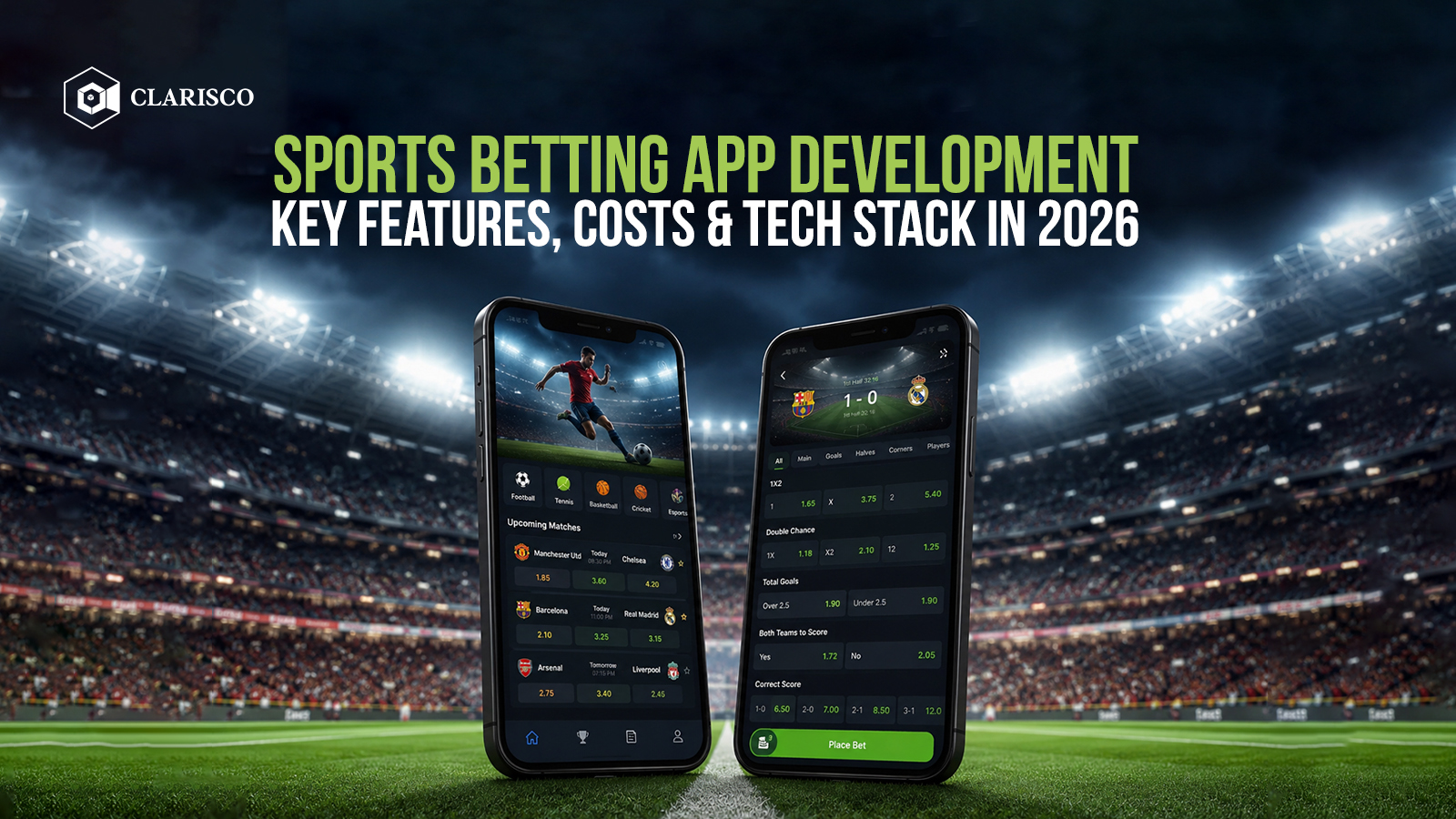
In-play betting now drives a major share of revenue for any competitive sportsbook. The platform needs real-time data feeds from sports data providers, low-latency odds update processing, and an interface that updates bet markets without page reloads.

 
  • Multi-Sport and Esports Coverage
 

Football dominates with 62.7% market share in 2026. But basketball, cricket, tennis, MMA, and esports all have significant and growing bettor bases. Esports specifically attracts users aged 18 to 34, the highest-value demographic for long-term platform engagement.

 
  • Cash Out and Partial Cash Out
 

The cash-out feature allows users to settle their bet early, taking a partial profit if the market has moved in their favor, or cutting losses before the match ends. It is one of the highest-engagement features on any modern sportsbook and a significant driver of same-session return visits.

 
  • Same-Game Parlays
 

Parlays combining multiple selections from the same match into a single bet have become one of the most popular bet types for recreational bettors. Building them requires real-time correlation modeling and the AI to price the parlay correctly while maintaining margin.

 
  • Payment Processing and Crypto Support
 

Multiple payment methods credit/debit cards, bank transfers, UPI in India, and wallets like Google Pay and Apple Pay are baseline. Wyoming's blockchain-based wagering experiment has accelerated interest in crypto-funded accounts across regulated markets.

 
  • KYC and AML Compliance Module
 

Geolocation verification, age verification, and identity document upload are required in every regulated market. The KYC module needs to be frictionless enough that it does not drive users to unregistered alternatives. AI-assisted document verification reduces manual review time while maintaining accuracy.

 
  • Responsible Gambling Tools
 

Self-exclusion, deposit limits, session time reminders, and AI-powered intervention when behavioral patterns suggest problem gambling are all standard requirements for licensing in the UK, EU, India, and UAE.


Sports Betting App Development Cost in 2026


Platform Tier

AI Level

Cost Range

Timeline

Basic MVP

Rule-based risk

$30,000 – $80,000

2 – 4 months

Standard Platform

Basic AI personalization

$80,000 – $200,000

4 – 8 months

Full-Featured Platform

Full AI suite

$200,000 – $500,000

6 – 12 months

Enterprise Sportsbook

Custom ML models

$500,000 – $1,500,000+

12 – 24 months


The largest single cost driver is live data feed licensing. Sportradar and Genius Sports charge $50,000 to $300,000+ annually, depending on sports coverage and geographic rights.


Tech Stack for Sports Betting App Development


Backend: Node.js or Python for core API services, Go or Rust for high-throughput odds processing and bet settlement logic where latency matters. PostgreSQL or MongoDB for bet and user data. Redis for real-time caching of live odds and market states.


Frontend: React Native for cross-platform iOS and Android apps. React with Next.js for the web interface. WebSocket connections for live odds updates without polling.


AI/ML Layer: Python with TensorFlow or PyTorch for odds modeling, fraud detection, and personalization models. Kafka or similar event streaming for processing real-time match data feeds. MLflow or similar for model versioning and monitoring in production.


Payments: Stripe, Razorpay (India), PayTabs (MENA), and blockchain wallet integrations via Web3.js or Wagmi for crypto payments.


Third-Party Integrations: Sportradar or Genius Sports for live data feeds. KYC providers (Jumio, Onfido, or regional equivalents). Geolocation APIs for jurisdiction enforcement.


Infrastructure: AWS or GCP with multi-region deployment for low-latency access across target markets. Redis-based session management. CDN for frontend delivery.


Legal and Regulatory Framework for Sports Betting Apps in 2026

 
  • United Kingdom
 

The UK is one of the most clearly regulated and operator-friendly markets for online sports betting app development in the world. The UK Gambling Commission (UKGC) issues licenses to private operators under the Gambling Act 2005. Any company offering sports betting to UK residents must hold a UKGC Operating License regardless of where the company is headquartered.


License requirements include AML and KYC controls, responsible gambling tools, segregated player funds, regular audit submissions, and compliance with the Advertising Standards Authority's gambling advertising rules.

 
  • European Union
 

EU member states regulate gambling at the national level; there is no single EU-wide sports betting license. Most major EU markets have their own national licensing bodies and separate application processes for each.


Germany's State Treaty on Gambling requires a federal license for sports betting operators, with strict advertising restrictions and a 5% betting tax. The Netherlands, which opened to private operators in 2021 under the KSA, has tightened enforcement on unlicensed operators. France permits sports betting and horse racing under ANJ licensing but prohibits online casinos.


For a sports betting app development company building for EU markets, multi-jurisdiction licensing is the standard path, typically starting with the Malta Gaming Authority (MGA) or Gibraltar.

 
  • United States
 

The US sports betting market operates at the state level following the Supreme Court's 2018 repeal of PASPA. As of 2026, 38 states and Washington, DC have legalized sports betting in some form.


Major licensed markets include New York, New Jersey, Pennsylvania, Ohio, Illinois, and Virginia. Bet365 is licensed in New Jersey, Ohio, Virginia, Colorado, Iowa, Kentucky, and Louisiana. Each state has its own application process, fee structure, tax rate, and compliance requirements.


For sports betting app development company projects targeting the US, the practical approach is to partner with a licensed operator in each target state since obtaining independent sportsbook licenses requires significant capital and regulatory standing, or to develop B2B platform software for existing licensees.

 
  • India PROG Act 2025 and Rules 2026
 

India underwent its most significant online gaming regulatory change in history in early 2026. The Promotion and Regulation of Online Gaming (PROG) Act 2025 and its accompanying Rules came into force on May 1, 2026.


The law establishes a central Online Gaming Authority and classifies all online games into three categories: online money games, permissible social games, and e-sports and competitive skill games.


UAE GCGRA and Play971


The UAE has historically maintained a strict prohibition on sports betting and gambling under federal law. That position has partially changed, but the change is more limited than many headlines suggest.


The General Commercial Gaming Regulatory Authority (GCGRA) was established and issued its first licensed sportsbook authorization to Play971 in 2025. As of mid-2026, Play971 remains the only legally licensed online sports betting platform operating inside the UAE. The GCGRA is building a single-regulator, limited-operator model rather than opening to competition.


Why Choose Clarisco as Your Betting App Development Company?


Clarisco Solutions builds sports betting platforms across the full stack: backend bet engine, real-time odds processing, AI personalization and fraud detection, multi-sport data feed integration, KYC compliance modules, payment processing, and mobile apps for iOS and Android.


The team's AI-powered sports betting app development services cover standard platform builds as well as fantasy sports betting app development and peer-to-peer sports betting app development projects. Whether the project targets India's fantasy sports market, a licensed offshore jurisdiction, or a UAE-based company building for international markets, Clarisco builds with the relevant regulatory and compliance architecture in mind from the start.


Final Words


The sports betting market at $126.51 billion in 2026 is not slowing down.


Mobile betting at 58.3% of total online wagering. Real-time in-play markets driven by AI odds engines. Esports capturing younger demographics across South Asia and Southeast Asia. Fantasy sports growing in markets where traditional betting regulation lags.


The apps that retain users are the ones that personalize, respond in real time, and build trust through transparent responsible gambling tools.

We'd Love To Hear From You!

Know your requirement, our technical expert will schedule a call and discuss your idea in detail. All information will be kept confidential.

Contact Us

Loading...

Skip the queue and book a call with our Founder

Founder
Priyadharshini Suriyanarayanan

Founder & CEO, Clarisco Solutions Private Limited

12+ years in AI, Web3, and enterprise software delivery. Led 650+ product launches across AI agents, generative AI, tokenization, crypto exchanges, DeFi, and NFT platforms. Specializes in AI-driven Web3 product engineering and regulation-ready system architecture.