Tokenization

Real World Asset Tokenization Development Company - An Overview

Share:
Founder

Author

Priyadharshini Suriyanarayanan
Founder Founder

Table of Contents

...

The tokenized real-world asset market crossed $60 billion in July 2026.

BCG projects $16 trillion in tokenized assets by 2030.

Standard Chartered forecasts $30 trillion by 2034.

McKinsey's conservative base case is $2 trillion by 2030.

BlackRock, Goldman Sachs, JPMorgan, Standard Chartered, and BNY Mellon all have active tokenization programs. Over 200 institutional RWA projects are underway, supported by more than 40 leading financial institutions.

The market is at its peak. And the companies building RWA Tokenization Platform Development foundation right now are the ones that will be positioned when the next wave of institutional capital arrives. Now, let's talk about Real World Asset Tokenization Development.

What Is Real World Asset Tokenization?

Real world asset tokenization is the process of converting ownership rights of a physical or financial asset into a digital token on a blockchain.

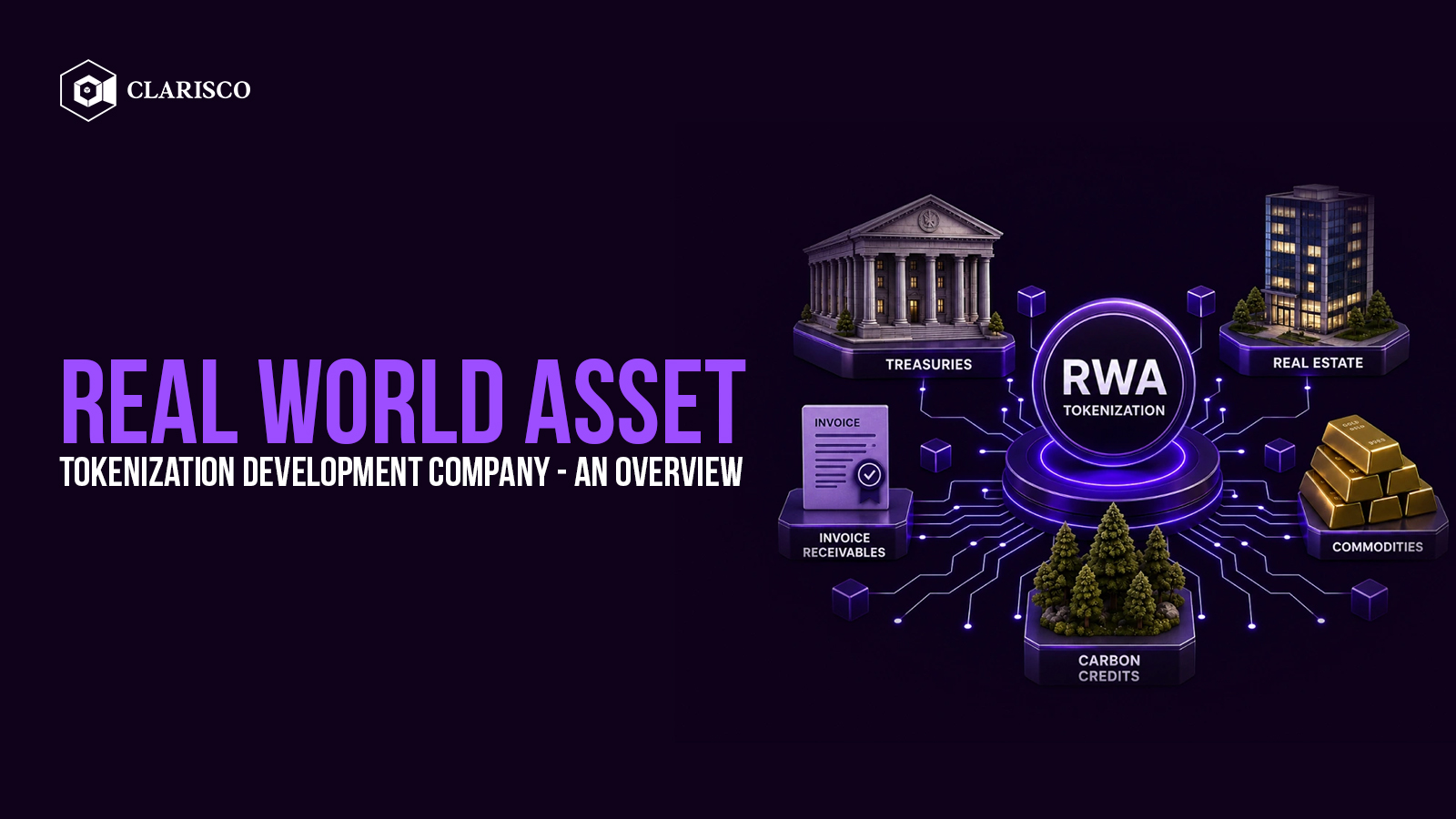
The underlying asset, like a commercial property, a government bond, a bar of gold, a private equity fund interest, a carbon credit, or a private loan, remains in the real world, held by a custodian or legal entity. What moves on-chain is a token that represents a verified claim on that asset.

How Does an Asset Tokenization Development Company Work?

The easy way to understand how real-world asset tokenization development companies work is through what it replaces. Traditional asset management involves paper documentation, manual settlement cycles that take days, and secondary markets that either do not exist.

Tokenization addresses each of those barriers at the foundation level. The blockchain ledger replaces paper documentation. Smart contracts replace manual settlement, and the token standard enforces compliance automatically. And the secondary market framework opens asset trading to a much wider investor base.

Tokenized Treasuries alone surged 80% year-to-date in 2025, reaching $7.4 billion. Private credit is the single largest tokenized asset class at $8 to $9 billion. Real estate tokenization, projected to grow from $120 billion in 2023 to $3.2 trillion by 2030, is the category with the highest investor interest.

Key Features for an RWA Tokenization Platform

A well-built RWA tokenization platform development project is a system of interconnected layers, each of which needs to be designed correctly for the platform to function at industry standards.

  • Compliance-Grade Token Standards

ERC-3643 is the dominant standard for institutional RWA tokenization in 2026. It enforces investor eligibility, transfer restrictions, and compliance rules directly at the smart contract level. ERC-1400 remains relevant for assets with complex partitioned ownership structures.

  • Oracle Integration for Real-Time Asset Pricing

For private credit and real estate platforms, oracle integration handles yield distribution triggers, automatically distributing rental income or loan interest to token holders when it is received by the custodian.

  • KYC and AML Compliance Module

Every asset tokenization development project handling regulated investor capital needs identity verification built into the onboarding flow. For multi-jurisdiction platforms, the compliance module needs jurisdiction-specific eligibility logic; accredited investor requirements differ between the US, EU, and Singapore, and the ability to update those requirements without redeploying the underlying contracts.

  • Secondary Market Foundation

Without a secondary market, token holders are just as locked in as traditional asset investors. With it, they can exit positions on their own timeline through a regulated marketplace.

  • Admin and Operator Dashboard

The platform operator needs full visibility into asset portfolio performance, investor compliance status, pending transfer requests, oracle health, distribution schedules, and audit trails, all accessible from a single interface.

  • Multi-Chain Architecture

Ethereum handles the majority of institutional RWA volume, but Arbitrum, Polygon, Base, and Avalanche each serve significant user bases. A real-world asset tokenization development company building for institutional scale needs to support at least two to three chains at launch.

The Business Benefits of an RWA Tokenization Platform

Liquidity for historically illiquid assets. Private equity, commercial real estate, private credit, and infrastructure assets have no functional secondary market in traditional finance. A tokenization platform creates one, allowing investors to exit positions in days rather than years.

In April 2026, Standard Chartered, BlackRock, and OKX launched a framework allowing qualified investors to use BlackRock's BUIDL fund as trading collateral, a direct example of tokenized assets creating liquidity that did not previously exist.

Institutional allocations can happen at any size. Retail-accessible products can start at $100. HNW investors plan to allocate 8.6% of portfolios to tokenized assets by 2026. Tokenization is the mechanism that connects that capital to asset classes that were previously accessible only above minimum investment thresholds of $1 million or more.

Real-time transparency through on-chain ownership records, oracle-verified pricing, and immutable transaction history gives investors and regulators the verification standards that are increasingly required.

A tokenized asset platform with a proper compliance framework can serve investors across jurisdictions that were previously inaccessible through regulatory or operational barriers to the underlying asset class.

Use Cases of an RWA Tokenization Platform Across Asset Classes

  • Real Estate Tokenization

Real estate is the most actively discussed tokenization category. BCG projects $5 trillion in tokenized real estate by 2030. The asset tokenization development solutions for real estate cover SPV formation, rental income distribution automation, secondary market access, and government registry integration where available.

  • Private Credit and Lending

Private credit is the largest tokenized asset class today at $8 to $9 billion. Centrifuge, Maple Finance, and institutional originators are building on-chain credit products that give investors access to yield profiles previously unavailable outside private placement markets.

  • Tokenized Treasuries and Fixed Income

Tokenized Treasuries are the fastest-growing segment, up 300% in 2025. BlackRock's BUIDL fund crossed $2.9 billion. The institutional adoption pattern for this asset class is the clearest proof point that real-world asset tokenization is past the proof-of-concept phase.

  • Private Equity and Venture Capital

Private equity accounts for the highest adoption rate among asset managers, as 53% of asset and wealth managers and 54% of institutional investors are participating. Equity tokens attract 46% of asset managers and 49% of institutional investors as an area of interest.

  • Commodities and Natural Resources

Tokenized gold through Paxos (PAXG) and Tether (XAUT) demonstrates the commodity tokenization model at scale. Gold tokenization gives investors on-chain exposure to a physical asset with verifiable proof of reserve. The same model applies to oil contracts, agricultural commodities, and energy derivatives.

  • Carbon Credits

Carbon credits tokenization is the highest-growth emerging category. The voluntary carbon market is projected to reach $50 billion by 2030. Blockchain-based tokenization prevents double-counting, the structural fraud problem that has undermined traditional carbon markets by creating an immutable record from issuance through retirement.

The Cost of Building an RWA Tokenization Platform

RWA tokenization platform development cost depends on asset class, the number of jurisdictions targeted, secondary market, and the depth of oracle and compliance.

Platform Tier

Development Cost

Timeline

Single-Asset MVP

$80,000 – $150,000

3 – 5 months

Multi-Asset Platform

$150,000 – $400,000

5 – 10 months

Institutional Platform

$400,000 – $700,000+

9 – 18 months

Budget $30,000 to $200,000 per jurisdiction depending on the asset class and the complexity of the regulatory framework. Smart contract audits add $20,000 to $75,000 and are non-negotiable for any platform handling real investor funds.

Regulatory Framework Surrounding RWA Tokenization

The regulatory frameworks are live. MiCA covers Europe. VARA covers the UAE. The SEC has expanded guidance on digital securities under permissioned networks. Germany and Luxembourg have enabled digital fund shares without paper certificates. The institutional infrastructure is in place, as BlackRock, Goldman Sachs, JPMorgan, and Standard Chartered are all active.

Why Choose Clarisco as Your RWA Tokenization Development Partner

Clarisco Solutions is a well-known real-world asset tokenization development company that builds top-rated tokenization platforms across every major asset class such as real estate, private credit, gold, carbon credits, private equity, and Treasuries.

The team's asset tokenization development services cover the complete build: ERC-3643 smart contracts with jurisdiction-specific compliance logic, Chainlink oracle integration for real-time asset pricing and proof-of-reserve attestations, KYC and AML modules, secondary market with compliant transfer enforcement, admin dashboards, and investor portals.

What separates Clarisco from general blockchain development firms is the combination of technical depth and operational knowledge of what real asset tokenization requires off-chain. SPV guidance, custody partner relationships, regulatory filing support, and post-launch monitoring are all part of a standard Clarisco engagement.

Whether you need a single-asset MVP to validate your market or a full institutional-grade RWA tokenization platform development system with oracle integration, multi-chain, and a regulated secondary market, Clarisco builds it with the operational realities of production asset management embedded.

Conclusion

The tokenized RWA market at $60 billion is not the story. The story is the gap between $60 billion and the most conservative projection for 2030, which is $2 trillion, a 30x increase in four years.

The RWA tokenization platform development foundation that connects real assets to the institutional capital that wants exposure to them. The companies building that framework in 2026, before the next wave of capital arrives, are the ones that will have established user bases, regulatory standing, and technical credibility when the market reaches its next inflection point.

The window to build first is open, and it will not stay at this size for long.

We'd Love To Hear From You!

Know your requirement, our technical expert will schedule a call and discuss your idea in detail. All information will be kept confidential.

Contact Us

Loading...

Skip the queue and book a call with our Founder

Founder
Priyadharshini Suriyanarayanan

Founder & CEO, Clarisco Solutions Private Limited

12+ years in AI, Web3, and enterprise software delivery. Led 650+ product launches across AI agents, generative AI, tokenization, crypto exchanges, DeFi, and NFT platforms. Specializes in AI-driven Web3 product engineering and regulation-ready system architecture.