Clarisco requests your action to continue
Table of Contents
AI will contribute $15.7 trillion to the global economy.
For the past few years, most of the investors have confidently invested a lot of money in AI startups rather than blockchain-based ones, even though blockchain has potential.
Nearly 88% of people use AI in at least one function of their business. 62% are still in their experimentation phase, and 7% use full-scale AI.
This shows that startups could bring not only innovative ideas but also generate enough profit with AI, making them give their full attention to adopting this AI technology.
For instance, Nvidia, one of the most active AI investors, backs companies such as OpenAI, Mistral, World Labs, Fireworks AI, and xAI.
Similarly, the blockchain market will soon reach 610.96 billion by the end of 2031. Still, some startups use black-box solutions from third parties.
Blockchain has revolutionised generations; cryptocurrency transactions come under the first generation. Ethereum's smart contracts are second-generation.
Presently, the third-generation blockchain-based AI solutions are facing some issues in scalability and cross-chain interoperability.
Have the challenges been solved? What will be the solution? This blog tells you exactly that. Read along.
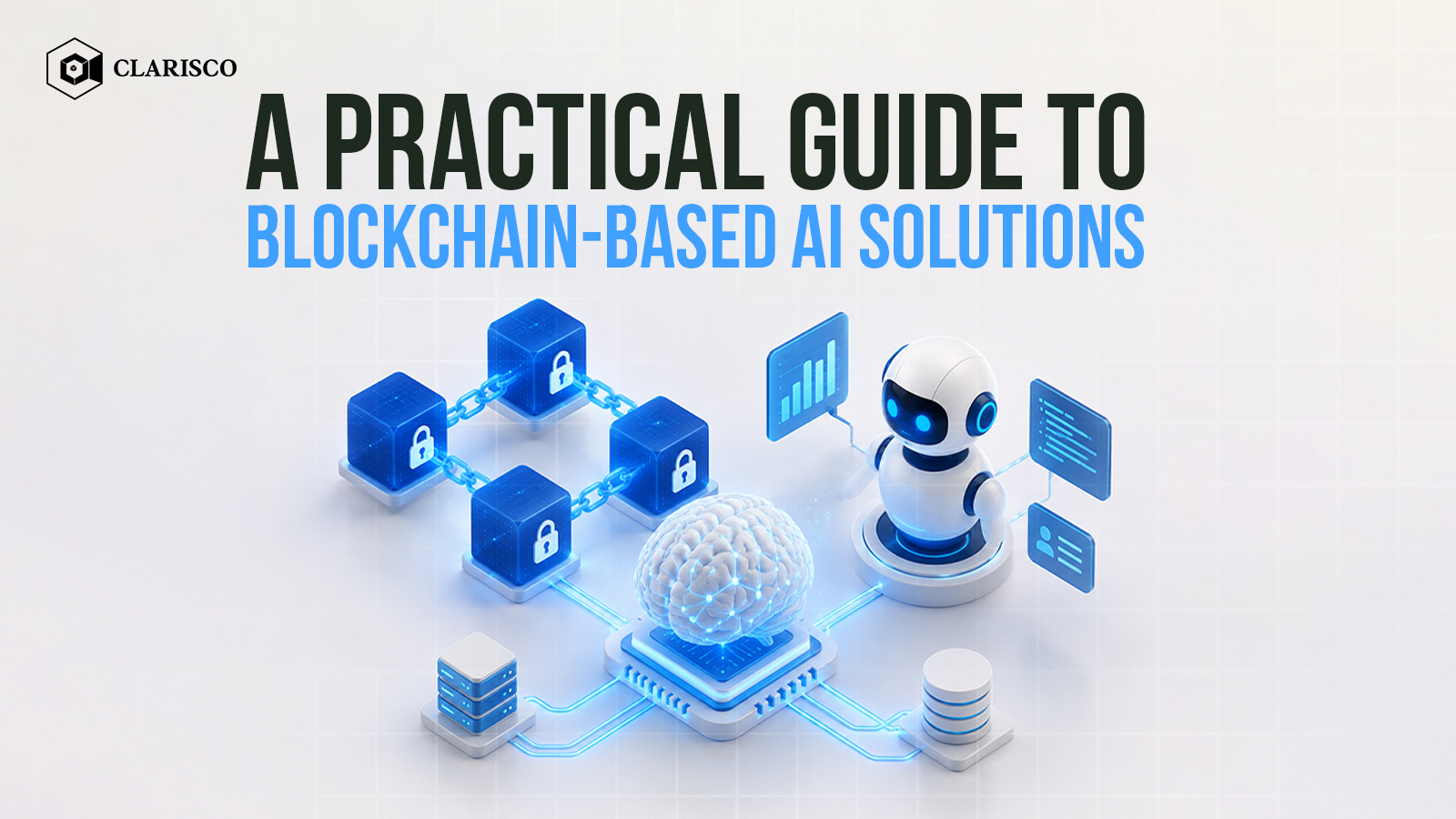
Blockchain-based AI solutions are applications/systems that combine blockchain technology and artificial intelligence. This helps improve security, transparency, trust, automation, and decentralization in AI-powered processes.
From manufacturing and healthcare to service providers, AI has become a top priority. Many firms depend on AI not only for the automation process but also for cybersecurity.
But attackers also use AI for phishing, malware practices, and vulnerability discovery. 68% of firms that use AI tools have experienced data leakage.
Still thinking about depending only on AI for cybersecurity? Let me tell you, cybercrime losses surpassed $20.9 billion. Why did this happen even with AI? Have you ever thought about that before?
AI can be your alert system, and it only has the ability to notify you whenever it detects suspicious activities, but when an attack occurs, it is not easy to collect any tamper-proof evidence.
Another stat states that the number of data breaches reached $4.44 million. This confirms that AI predicts the results by scraping your personal information, consumers, and competitors, which does not provide us with privacy or ownership.
So, how do you protect your customers’ sensitive data from threats?
AI blockchain resolves this by enhancing security. Blockchain is an open and public digital ledger where transactional data is stored in blocks and shared across thousands of computers within a network. Registered data cannot be altered or erased.
It records every input data that is given to the AI model, tracks how the data is being used, analyzes where it comes from, and ensures data integrity.
Blockchain’s tamper-proof recording ability assists in determining the ownership conflicts.
It continuously tracks every time the AI model is updated, the history, and how well it performs, which helps the owners review and verify them anytime in the future.
With blockchain-based AI solutions, firms now make their systems more transparent.
Blockchain AI can become a perfect duo, but it still requires skilled people, governance policy, risk assessment, and a model validation process.
1. Digital Asset Management
The number of global crypto and digital asset users is nearly 994 million. So there is a strong need for systems that provide compliance controls, risk assessments in real-time, and automate routine workflows in tokenised securities.
AI is structuring bonds according to market demand, tracking reserve levels, and detecting any abnormalities to prevent any illegal transactions. On the other hand, the blockchain makes settlements faster, securing information.
Blockchain technology is predicted to make $3.1 trillion in business value. Currently, AI and blockchain are already being implemented by large financial organizations for managing tokenised bonds, stablecoins, fund management, and digital asset custody.
For example, Franklin Templeton's FOBXX fund manages more than $740 million in on-chain assets, automating fund operations, reducing settlement times from days to near-instant transactions, and providing investors with greater transparency into portfolio holdings.
2. Smart Contracts
Smart contracts are digital agreements that operate automatically in blockchain systems without any intermediaries.
Delaware passed Senate Bill 69 in 2017 regarding the implementation of blockchain technology. This bill eliminated the need for traditional bosses, CEOs, and salary sheets.
It allows all DAOs to start building their own software contracts on blockchain, in which they register their ownership, corporate structure, rights, and salary distributions.
From then up to now, there are more than 200 million people who use smart contracts around the world. Intelligent contracts have been used in areas such as supply chain, healthcare, real estate tokenization, legal, and so on. Why intelligence contracts?
AI-integrated smart contracts eliminate limitations; they use both blockchain and AI models and agents along with data in real time, and thus can make decisions and act according to changed circumstances.
For example, Arizona allows legal agreements to be created via smart contracts.
Zilliqa is developing advanced computational capabilities with its proprietary smart contract programming language.
3. Personal ID Verification
Gen AI's ability to generate highly realistic images, videos, music, and even text from even the uncompleted or basic inputs increases the usage of the model.
However, this potential also brings along the risk of spreading misinformation, generating deep fakes, and manipulating public opinion. When analyzing surveys, it is found that an average of $184 million is lost by companies each year.
Blockchain offers a solution to this problem through its ability to provide immutable proof of the original source of the content, the timestamp, and whether it has been manipulated. Nearly saves 30% of administrative costs for owners.
The use of generative AI blockchain technology through Non-Fungible Tokens (NFTs) is one example of this.
4. Financial Services
Decentralized finance (DeFi) offers free and open financial services that anyone who is online can access.
With the integration of AI into DeFi, smart systems will be able to automate payments, transactions, and financial processes without any involvement of banks or other third parties.
Also, AI may process data about the market, improve strategies for investments, and make quicker decisions according to pre-set objectives.
5. Logistics
Logistics often lacks communication and is limited in visibility, which is because multiple logistics providers manage their own ledgers. These two issues can be solved by the blockchain, creating a shared and secure ledger that everyone can access to the same information.
So, here, the transparency and trust are improved among stakeholders, and delays that are caused by the manual paperwork are also minimised.
When combined with AI, supply chains benefit even more. AI can analyze shipment data, predict delivery delays, optimize routes, and identify anomalies in real time, while blockchain securely records every step of a product's journey.
One of the best use cases for blockchain-based AI solutions is decentralised AI. It is the integration of artificial intelligence with decentralized technologies like blockchain.
Ben, a senior blockchain analyst, states that decentralised AI is getting more popular lately because advanced AI is becoming permission-based.
Some service providers have already put limitations on some regions, and soon, access to advanced AI models will require identification and authorisation.
As a result, people started utilizing open alternatives such as Llama, Kimi, and DeepSeek. This transition brings opportunities for decentralised AI.
Blockchain uses its decentralised network to help multiple participants work together without a central authority or to share computing systems in a network. Research found that even the LLMs with ten billion parameters can be trained in a decentralised network.
Think about how Bitcoin reduces the dependency on traditional banks, and Bittensor lets participants earn TAO tokens for contributing useful AI services, reducing the dependency on centralized providers when developing powerful AI systems.
Decentralised AI blockchain would be the most promising development in the years to come.
For business owners, incorporating intelligence is one of the fastest ways to cut down operating costs.
Not every AI tool needs a blockchain. Here is the guide to help you evaluate which AI solutions can and should be integrated with blockchain technology.
Best for Decentralized AI
AI Chatbots: Cut hosting costs by 50–70% and keep chatbots running smoothly by using unused computing power from around the world.
Forecasting Tools: Get better sales, revenue, and inventory predictions by comparing results from many AI models.
Media & Design Tools: Create videos, 3D models, and graphics without buying expensive hardware by renting powerful GPUs when needed.
Hybrid Use Cases
Accounting Assistants: Keep a secure record of invoice approvals and expenses without sharing sensitive financial data.
HR Screening Tools: Save AI hiring decisions on a blockchain to prove fair and consistent recruitment.
Fraud Detection Systems: Detect fraud instantly using cloud servers and store security records on a blockchain for future checks.
Though there are a lot of advantages of such an approach, several issues must be considered when introducing blockchain-based AI solutions.
Speed and Security Trade-off
The AI applications will need to process the data and provide insights in real time. At the same time, the validation process in the blockchain system is based on consensus algorithms, which take some time. So it becomes difficult to maintain both security and speed at the same time as the company grows.
Integration with the Current Infrastructure
Nowadays, many businesses use traditional systems for financial operations, supply chain management, etc. The introduction of openledger AI blockchain technology implies some investments and a certain level of effort on the part of the developers. Moreover, the compliance regulations in the region might influence the process of integration.
Security and Reliability Issues
AI models, smart contracts, and dApps should be designed and tested carefully by an AI blockchain developer. Any possible vulnerability might lead to the leakage of information and other negative consequences. That is why constant auditing and monitoring of the system are necessary.
However, these challenges can be overcome through proper AI blockchain development strategies by the AI blockchain companies.
The first step at Clarisco is always to understand the business objectives and the existing system of the client.
Using this knowledge, we then proceed to develop blockchain-based architectures that are capable of handling increasing loads and integrating AI features into the existing systems without disturbing their functionality.
In addition, we do testing, smart contract audit, and optimization to ensure that the developed system will withstand increasing demands as more users adopt it.
With a proper focus on scalability, security, and AI, blockchain integration becomes easier.
Blockchain-based AI solutions are not an all-in-one tool, but they do hold the potential to tackle several issues that come with the implementation of AI, such as high expenses, lack of transparency, and data integrity problems.
The decentralization technologies allow organizations to provide a safer environment for consumers by developing AI blockchain solutions.
Organizations that carefully plan and execute blockchain, where it adds real value, positioned themself better to scale their AI initiatives with confidence.
Are you looking for ways to increase the transparency and reliability of your AI products? It is time to think about enforcing blockchain in your organization's projects.
Connect with our team now!
We'd Love To Hear From You!
Know your requirement, our technical expert will schedule a call and discuss your idea in detail. All information will be kept confidential.
Contact Us
Skip the queue and book a call with our Founder
Founder & CEO, Clarisco Solutions Private Limited
12+ years in AI, Web3, and enterprise software delivery. Led 650+ product launches across AI agents, generative AI, tokenization, crypto exchanges, DeFi, and NFT platforms. Specializes in AI-driven Web3 product engineering and regulation-ready system architecture.
Plot No. 29, 30, Iswarya Nagar,
Madakkulam, Tamil Nadu 625003, India
[email protected] +91 9442430551Monday-Saturday: 10am - 7pm
Sunday: Closed