Contact Us
Your Next Big Move Starts Here
Clarisco requests your action to continue
Table of Contents
The Founder and CEO of Clarisco Solutions Private Limited, a product engineering company focused on AI and Web3 development.
With over 12 years of experience in AI, blockchain, and enterprise software, she has led more than 650 product launches across categories including crypto exchanges, DeFi protocols, AI agents, generative AI products, tokenisation platforms, and NFT ecosystems.
She specializes in AI-driven Web3 product engineering and has built a reputation for delivering systems that work in production environments.
Wallets are where crypto gets lost. Bybit lost $1.5 billion in the largest crypto theft on record, Bitget lost about $387.5 million in September 2026, and a firmware flaw let thieves take 1,082 BTC from Coldcard users. It is clear that violent attacks on crypto holders are rising. Despite this, crypto wallet demand is increasing, and the market is growing at a 26.6% CAGR.
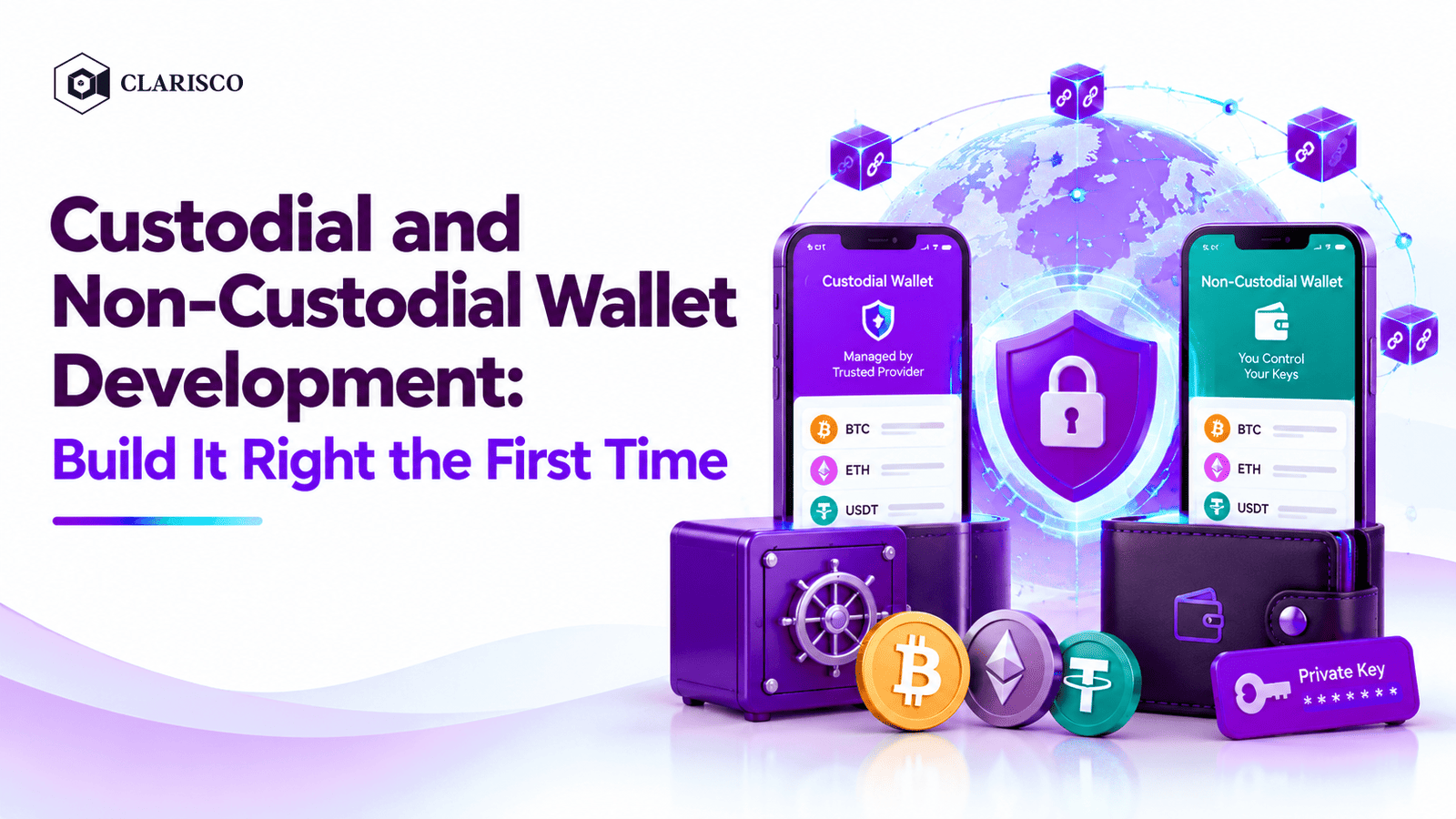
Also, one weak point in key management can cost you users and trust while building a wallet. This is what makes security a priority, and it is why custodial and non-custodial wallet development requires a skilled partner. This guide explains both wallet types, development costs, differences, and helps you choose the right one to build.
One of the major players in the digital asset ecosystem, Tether, has launched its own self-custodial wallet, called tether.wallet. Its wallet supports Tether-related stablecoins, such as USAT, XAUT, and even Bitcoin. The world's largest stablecoin issuer is moving into the wallet space; by doing so, it captures the attention of those who are looking for crypto wallet development.
The global crypto market is growing rapidly in an unimaginable way; as a result, Grandview Research predicted that the market will reach $19.3B this year and could reach $100.8B by 2033.
Let’s see what other factors drive the growth of this market.
CoinSlaw statistics state that 41% of users use this custodial wallet model. Here, a virtual asset service provider, such as an exchange, trading platform, or brokerage-style service, stores and manages keys while only letting users access their digital assets through those keys and view their digital balances.
This type of wallet works exactly like third-party banking applications. First, users create their account by setting a passcode, perform identity verification, and once the process is done, the platform takes care of the rest of the process. In case users lose their account, they can retrieve it using backup phrases.
Advantages | Disadvantages |
Provides high security | The custodian also has control over your funds |
Easy account recovery using backup phrases | Can pause transactions and set withdrawal limits |
Platform handles the entire process after setup | Identity verification is required
|
Works like a familiar banking-style app | A breach can still occur, denying access to your digital assets |
Examples of Custodial Wallets
Surveys suggest that around 59% of crypto users around the world choose non-custodial wallets, also known as self-custody wallets. These put the private keys in the user’s own hands, so no outside company can step in and take charge of the funds. Setting one up produces a recovery phrase of 12 or 24 words, which acts as the master backup for getting back into your assets.
This model suits people who use DeFi often. Rather than moving your assets onto a platform, you simply connect your wallet straight to the application you want to use.
Advantages | Disadvantages |
Nobody can lock or freeze your holdings | Responsibility is entirely yours |
The rules can’t be rewritten on you | No support team to help you |
No exposure to a company collapsing | No way to reset a forgotten password |
Connects straight to DeFi apps without moving assets | Losing your key or phrase means losing your funds permanently |
Examples of Non-Custodial Wallets
Feature | Custodial Wallet | Non-Custodial Wallet |
Private key control | Managed by a third party | Controlled by the user |
Asset control | Depends on the custodian's services and policies | User controls wallet access through their keys |
Account recovery | Usually through provider account recovery | Through a recovery phrase or supported backup method |
Ease of use | Generally easier for beginners | Requires careful key management |
Security responsibility | Shared between provider and user | Primarily the user's responsibility |
Transaction control | Subject to provider policies | Users authorize transactions |
KYC verification | Common on centralized exchanges | Depends on connected services |
Main risks | Provider failure or account restrictions | Lost keys, scams, or malicious transactions |
Custodial Wallets
In the US, wallet service providers could be required to register with FinCEN as money services businesses and adhere to Bank Secrecy Act regulations, depending on what they do. They could also require state money transmission licenses. For example, in New York, for instance, wallet providers dealing with virtual currency could require a BitLicense or an eligible banking charter.
Non-Custodial Wallets
The companies that solely provide non-custodial wallet software in the US don’t require a financial services license for just offering the software. But if they are trading crypto, transferring assets on behalf of their customers, or engaging in other regulated activities, then some additional requirements might be required. Sanctions obligations have to be considered by the providers as well.
Compliance Trends in the US
US regulatory authorities do not consider whether your wallet is custodial or non-custodial; they only pay attention to how your firm operates. All of the above requirements, including customer asset protection, rely on the services you provide and the location of your business.
Custodial Wallet
Non-Custodial Wallet
Wallet Type | Estimated Wallet Cost | Cost Drivers |
Basic custodial wallet | $25,000– $55,000 | Key management, withdrawals, deposits, user accounts |
Advanced custodial wallet | $50,000– $120,000+ | Custody infrastructure, compliance features, transaction monitoring |
Basic non-custodial wallet | $20,000– $40,000 | Key generation, recovery phrase, transaction signing |
Advanced non-custodial wallet | $35,000– $80,000+ | Multi-chain support, dApp connections, token swaps |
Enterprise wallet | $100,000– $500,000+ | Advanced security, MPC, audits, institutional features |
1. Binance
An example of a custodial wallet that works with a cryptocurrency exchange is Binance. People can buy and keep cryptocurrency and do not need to take care of their private keys. According to reports from April 2026, Binance had 316 million users with user assets of around $150 billion.
2. Coinbase
Coinbase offers people both custodial crypto wallets for trading and storing cryptocurrency. According to quarterly reports for 2026, Coinbase had 7.6 million transacting users per month and $245.9 billion in assets as of June 30, 2026.
3. BitGo
The emphasis of BitGo is not on consumer wallets but on institutional custody services. In Q2 2026, the company recorded 5,833 customers and $65.2 billion of assets managed on its platform.
4. Fireblocks
Fireblocks is the provider of digital asset technology for business purposes, such as wallet operations, transaction authorization, and MPC technology for key management. The platform caters to more than 2,400 businesses and has managed digital asset transactions worth over $10 trillion.
1. Trust Wallet
Trust Wallet is a self-custodial wallet that allows you to store your crypto assets and interact with Web3 applications. It claims to have over 200 million users. You own your wallet recovery seed phrase, which means that you can control your assets without having to use a centralized exchange storing your private keys.
2. MetaMask
MetaMask is widely used to interact with Ethereum-based networks and DApps. This wallet model has more than 100 million downloads and users from 190+ countries.
3. Ledger
Ledger has hardware wallets that allow protection of private keys using special devices. More than 8 million devices have been sold by the company in over 200 countries.
4. Exodus
Exodus wallet allows self-custody of supported cryptocurrencies using the platform on both mobile and desktop platforms. It had 1.4 million monthly active users, 1.3 million quarterly funded users, and a swap volume of $1.1 billion in Q2 2026.
1. AI-Powered Smart Wallets
There will be smart custodial and non-custodial crypto wallets that are integrated with AI features, which easily detect suspicious activities and scams instantly, explain smart contract risks before they happen, and also suggest how users can minimize transaction costs.
2. Beyond Seed Phrases
Custodial and non-custodial crypto wallets could have passkeys, social recovery, Multi-Party Computation, and account abstraction, along with other technologies, which provide strong security and wallet recovery options, so there is no need to manage seed phrases manually.
3. Wallets as Web3 Gateways
Wallets are moving beyond being simply a place to store crypto and have become an important access point to DeFi, NFT markets, blockchain games, DAOs, and other Web3 products.
4. Digital Identity Management
Wallets could become another safe place to store decentralised identities, verifiable credentials, and privacy-preserving identity proofs in a single place. With this feature, people can access the exact information they need on the internet without giving their personal details.
5. Payments Using Stablecoins
The features of stablecoin integration, fiat on-ramps, merchant integration, and crypto payment card functionality can increase the utility of wallets for real-world payments.
1. How fast do you need to move between rupees and crypto?
If you want to top up through UPI, a bank transfer, or a card and be trading within minutes, a custodial exchange app is the smoother route. It's built for exactly that convenience, and the learning curve is gentle.
2. How much are you actually putting in?
If it's pocket money you could lose without losing sleep, such as an amount you're using to learn, custodial is fine. If it's a serious sum you plan to hold for years, take the keys into your own hands, ideally on a hardware wallet that keeps them offline.
3. Can you be your own security guard?
Be honest when asking this of yourself:
Can you write your seed phrase, keep it offline, and store a second copy somewhere safe?
Can you find a phishing link, a fake wallet app, or a "support agent" scammer?
If yes is your answer, then non-custodial wallet development suits you. If you hesitate on either, a custodial wallet development protects you from your own slip-ups.
4. Are you looking to go beyond just buying and holding?
For staking, lending, borrowing, minting NFTs, and using Decentralized applications, you need to have a wallet that you have access to. While some of these can be achieved through exchanges, the complete range can only be unlocked through a non-custodial wallet.
5. How much do privacy and independence matter to you?
If handing over personal identification makes you uneasy, or if you worry about the constant threat of your account being suddenly frozen, non-custodial wallets protect you against both concerns.
Clarisco, a leading crypto wallet development company and was founded in 2016. Since then, we've delivered 600+ projects across countries, and the majority of our clients are satisfied with our outcomes and keep us as their project development partner.
Our primary focus is building CEX, DEX, crypto wallet development, and smart contract integrations. We have already developed exchange scripts, white-label crypto wallets, and multi-chain wallets for you.
We specialize in building clone applications and non-custodial wallet software development, such as an app like MetaMask and a Trust Wallet clone; for custodial crypto wallet development, we provide an MPC wallet.
Product development costs vary based on the business needs. For further maintenance and updates, if needed, we can help you. Connect with us and let's discuss further!
We'd Love To Hear From You!
Know your requirement, our technical expert will schedule a call and discuss your idea in detail. All information will be kept confidential.
Contact Us
Skip the queue and book a call with our Founder
Founder & CEO, Clarisco Solutions Private Limited
12+ years in AI, Web3, and enterprise software delivery. Led 650+ product launches across AI agents, generative AI, tokenization, crypto exchanges, DeFi, and NFT platforms. Specializes in AI-driven Web3 product engineering and regulation-ready system architecture.
Plot No. 29, 30, Iswarya Nagar,
Madakkulam, Tamil Nadu 625003, India
[email protected] +91 9442430551Monday-Saturday: 10am - 7pm
Sunday: Closed