Tokenization

10 Best RWA Tokenization Platform Development Companies For US Businesses

Share:
Founder

Author

Priyadharshini Suriyanarayanan
Founder Founder

Table of Contents

...

The tokenized real-world asset market crossed $60 billion in July 2026.

Standard Chartered forecasts $30 trillion by 2034. BCG projects $16 trillion by 2030. The DTCC, which clears over $2 quadrillion in securities annually, received an SEC no-action letter to operate a tokenized securities service.

For US businesses, asset managers, fintech operators, real estate firms, and private equity funds, building the platform right now. But building a real-world asset tokenization platform requires a lot, including both investor needs and SEC standards.

That's why we came up with this blog. It explains what an RWA tokenization platform development project requires, the cost to develop it, how to launch compliantly in the US, and the 10 companies best positioned for 2026 and beyond.

What is RWA Tokenization?

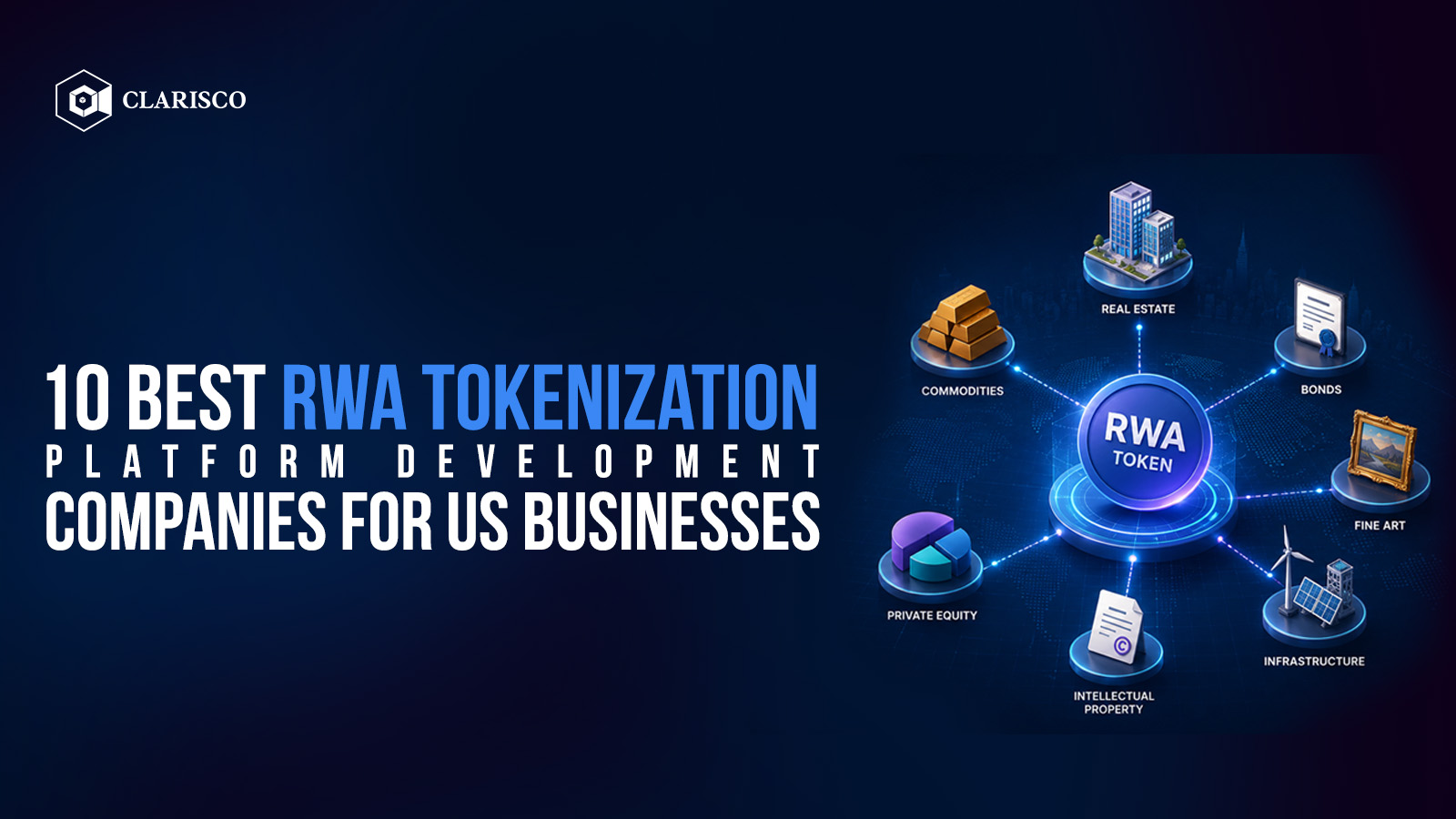
Real-world asset tokenization development is the process of converting ownership rights of a physical or financial asset into a digital token on a blockchain. The underlying asset, such as property, bonds, gold, private equity, private credit, and carbon credits, stays in the real world, held by a custodian or legal entity.

The token on-chain represents a verified fractional claim on that asset, with the same legal rights as traditional ownership. For US businesses, asset tokenization development specifically requires an addition of regulatory design. Every token issuance needs to be structured under an applicable exemption or as a registered security with the SEC.

Key Features for a US-Regulated RWA Tokenization Platform in 2026

A futuristic Real-world asset tokenization platform built for US businesses needs these components working as an integrated system.

  • ERC-3643 Compliant Token Issuance

ERC-3643 enforces investor eligibility and transfer restrictions directly at the smart contract level. For US platforms, this means accredited investor verification is enforced on-chain, as a transfer to an unverified wallet is blocked automatically.

  • Custodian Integration and Proof of Reserve

Every tokenized asset needs a custodian holding the real-world asset and providing periodic attestations that the on-chain token supply accurately reflects the physical holdings. For US platforms, custodians need to be FDIC-insured, trust-charter licensed, or otherwise qualified under applicable frameworks.

  • KYC and AML for US Requirements

Financial Crimes Enforcement Network (FinCEN) regulations, Bank Secrecy Act compliance, and state money transmitter licensing all impose specific KYC and AML requirements on US-operated token platforms. The compliance module needs to support tiered due diligence too.

  • Secondary Market Infrastructure

SEC guidance requires that secondary trading of tokenized securities happens through registered broker-dealers or alternative trading systems (ATS). A US-compliant secondary market module needs to be designed with either an ATS partnership or an SEC broker-dealer integration.

  • Admin and Compliance Dashboard

Real-time visibility into investor compliance status, oracle feed health, pending transfer requests, distribution schedules, and audit trails, all in a single interface accessible to authorized compliance staff.

10 Best RWA Tokenization Platform Development Companies For US Businesses

1. Clarisco Solutions

Headquarters: India (US client focus)

Specialization: Full-stack RWA tokenization platform development across all asset classes and regulatory frameworks

Clarisco Solutions is the #1 RWA tokenization platform development company for US businesses in 2026. It is the only development partner on this list that combines end-to-end technical delivery, US regulatory architecture, and post-launch operational support across every major asset class.

What Clarisco Solutions Builds

Clarisco handles the full technical stack for any real-world asset tokenization development project. Every platform is built to the specific requirements of the asset class, investor base, and the target regulatory framework, including

  • Smart Contract and Token Issuance Layer
  • Oracle Integration and Real-Time Asset Pricing
  • KYC and AML Compliance for US Regulatory Requirements
  • Secondary Market Framework with ATS Connectivity
  • Custody Integration and Proof of Reserve
  • Cap Table and Registry Management
  • Automated Capital Calls and Waterfall Distributions
  • Admin Dashboard and Investor Portal
  • Multi-Chain Architecture
  • Post-Launch Operational Support

Asset Classes Clarisco Has Shipped

Real estate, private equity, private credit, gold, carbon credits, tokenized Treasuries, and money market fund interests.

US Regulatory Structuring Guidance

Clarisco's engagements include regulatory structuring guidance so that the smart contract architecture satisfies the Regulation D, Regulation S, or Regulation A+ structure that legal counsel is building.

Who Can Build with Clarisco

US asset managers, real estate platforms, private equity fund operators, fintech companies, and enterprises across any asset class that need a trusted asset tokenization development company.

2. Centrifuge

Headquarters: Berlin, Germany

Specialization: Private credit and off-chain asset tokenization

Centrifuge built the protocol for tokenizing private credit assets such as invoices, private loans, and accounts receivable and connecting them to DeFi liquidity pools. It processes hundreds of millions in on-chain private credit and provides the infrastructure layer for institutional originators accessing DeFi capital.

3. Tokeny Solutions

Headquarters: Luxembourg

Specialization: ERC-3643 compliance and institutional token issuance

Tokeny built ERC-3643 and has tokenized over $32 billion across real estate, bonds, and funds. After its 2025 acquisition by Apex Group, it has direct connections into global fund administration. For US businesses targeting cross-border investors who also need MiCA compliance alongside Regulation D, Tokeny's framework is the most mature available.

4. Maple Finance

Headquarters: Dublin, Ireland

Specialization: Institutional on-chain credit lending and private credit tokenization

Maple Finance operates as an on-chain credit marketplace connecting institutional lenders with borrowers, with loan pools tokenized and accessible to qualified investors. It has processed over $4.5 billion in total loans across Ethereum, Solana, and Base. Maple's Syrup product offers institutional-grade yield through tokenized credit exposure.

5. S-Pro

Headquarters: Eastern Europe

Specialization: Regulated real-world asset tokenization platforms

S-Pro has over 8 years in the blockchain space and focuses on regulated real-world asset tokenization platforms. Its work with Sygnum Bank, the world's first regulated digital asset bank, demonstrates institutional security standards. It covers real estate, art, private equity, and bonds across multiple blockchains, including Ethereum and Polygon.

6. Securitize

Headquarters: Miami, USA

Specialization: SEC-registered institutional digital securities and fund administration

Securitize is the institutional benchmark for SEC-regulated tokenized securities. It operates as an SEC-registered transfer agent, runs a licensed ATS for secondary liquidity, and administers over $38 billion in digital assets, including BlackRock's BUIDL fund. For US businesses that need the highest tier of SEC compliance infrastructure and institutional pricing, Securitize is the established reference point.

7. Polymath / Polymesh

Headquarters: Cayman Islands

Specialization: Institutional blockchain for regulated securities

Polymath operates the Polymesh blockchain, built specifically for regulated financial assets. It incorporates on-chain identity verification, deterministic settlement, and governance designed for securities regulation compliance. For US businesses that need an institutional blockchain rather than EVM deployment for their tokenized equity or fund products.

8. RealT

Headquarters: Miami, USA

Specialization: Fractional real estate tokenization with retail investor access

RealT has tokenized over 400 properties with more than 15,000 active investors receiving weekly rental distributions through smart contracts. It operates one of the few retail-accessible real estate tokenization platforms with a proven, sustained income distribution track record.

9. Ondo Finance

Headquarters: New York, USA

Specialization: Tokenized US Treasuries, money market funds, and global equity products

Ondo Finance grew from $40 million to $2.5 billion in TVL in under two years. Its OUSG (Treasury fund) and USDY products, plus Global Markets tokenized stocks and ETFs, are among the most-cited production examples of institutional RWA tokenization done at scale. The SEC closed its investigation without charges in November 2025.

10. tZERO

Headquarters: Salt Lake City, Utah, USA

Specialization: SEC-regulated digital securities trading platform and ATS

tZERO operates as both a tokenization platform and a licensed alternative trading system for digital securities. It processed $200 million in commercial real estate tokenizations in 2025. For US businesses that need an integrated issuance and secondary trading venue, particularly in commercial real estate.

Estimated Cost of Building an RWA Tokenization Platform

RWA tokenization platform development cost for US-focused builds includes both the technical development and the US regulatory setup, which is a significant cost variable most non-US-focused guides underestimate.

Platform Tier

Development Cost

Timeline

Regulation D MVP

$80,000 – $160,000

3 – 5 months

Multi-Asset Platform

$160,000 – $380,000

5 – 10 months

Institutional Platform

$380,000 – $750,000+

9 – 18 months

How to Launch a Regulated RWA Tokenization Platform in the US

The US regulatory path for a US project by an RWA tokenization platform development company is more structured than at any prior point, and both more demanding and more navigable.

Step 1 - Choose your exemption or registration path

Step 2 - Establish the legal entity and asset

Step 3 - Engage an SEC-registered transfer agent

Step 4 - Build with a US compliance framework embedded

Step 5 - Establish ATS connectivity for secondary trading

Step 6 - FinCEN registration and BSA compliance program

Step 7 - Launch with ongoing compliance

Final Words

The tokenized RWA market surpassed $60 billion in July 2026 and is on track to exceed projections that would make today's figure look like a footnote.

The 10 companies on this list represent different strengths, and the right choice depends on the asset class, investor base, and the regulatory structure.

A real-world asset tokenization development company that does not understand US regulatory requirements is not the right partner for a US-facing platform, so choose wisely and build.

We'd Love To Hear From You!

Know your requirement, our technical expert will schedule a call and discuss your idea in detail. All information will be kept confidential.

Contact Us

Loading...

Skip the queue and book a call with our Founder

Founder
Priyadharshini Suriyanarayanan

Founder & CEO, Clarisco Solutions Private Limited

12+ years in AI, Web3, and enterprise software delivery. Led 650+ product launches across AI agents, generative AI, tokenization, crypto exchanges, DeFi, and NFT platforms. Specializes in AI-driven Web3 product engineering and regulation-ready system architecture.